 By
By One of the places that has always remained very close to the top of my bucket list is India. With a population of over 1.3 billion and almost half being below the poverty line, I was apprehensive as to what I would encounter during my trip. Undeterred and determined, off I headed to the very touristy Golden Triangle, eager to learn about more about this vast country than just the glitz and glam of the Taj Mahal.
Delhi
Arriving in Delhi, we made our way to the 5* LaLiT Hotel. The people and service here are exemplary, the staff literally cannot do enough for you. This hotel promotes itself as gender agnostic with a ‘pure love’ message showing a true respect for sexual, religious and cultural diversity. It does so in such a way where it is not thrust into peoples faces, or shouted from the rooftops. For example, the rainbow badges that the staff wore were a nice touch that would be noticed by those who care to acknowledge such details.
Venturing out in to New Delhi we were surprised at just how much British influence still remained in the area. The British inhabited India for over two centuries and accents of this history remain very prominent in the architecture and road systems of the city.


India Gate (or India War Memorial) was our first stop of the day. This memorial is to commemorate the 82,000 soldiers who died in the first world war and is inscribed with over 13,000 of their names. Below the arch sits the flame of the immortal soldier (Amar Jawan Jyoti) which is guarded 24 hours per day, 365 days of the year by the three Indian armed forces, Army, Navy and Air Force.

Whilst visiting this monument it was warming to see the number of families present in the area. They seemed to have travelled from all around India to visit, learn about and commemorate their county’s history. This was however, also our first taste of the street hawkers that we were to encounter throughout our trip. From refilled bottles of water and soda promising the dreaded Delhi Belly, to ‘professional’ photos taken at the monument, with no actual cameras in sight, each person was clearly trying to take advantage of the fact that the monument attracts such high numbers of tourists even during the off peak season.


Moving on to Humayun’s Tomb, this is where I started I realized the importance of symmetry in the architecture here. Commissioned by the first wife of Humayan (second Emperor of the Mughal Empire) and overseen by a Persian architect, I was confused to see what looked like the Star of David , decorating some of the moldings. However on closer inspection I could see that these stars contained a lotus flower at their center and are actually used as an ‘ornamental cosmic symbol’.
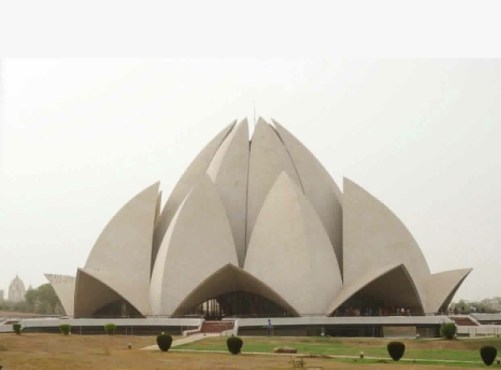
The lotus flower is often used in Indian architecture as a symbol of beauty and purity but not only as decoration. The Lotus Temple, built in 1986, is open to all people, regardless of their religion, as a place of reflection and meditation.
Tip: Be aware when visiting that there are 3 queues before entering the temple, each taking more than half an hour to navigate through, with no shade to protect you from the scorching summer sun.


On to Old Delhi and we finally started to encounter the India that all the stereotypes allude to, crowded streets full of tuk tuks, carts, people and cows, a jungle of telephone lines and an abundance of colour.


Visiting Jama Masjid, one of the largest Mosques in India accommodating up to 25,0000 in its courtyard, we saw preparations for the up coming Eid celebrations.


Whilst we were encouraged not to give money to the children we encountered in the mosque, we could not resist their requests for chocolate and sweets. In a world where many youngsters are running around with endless types of technology, the children here were content playing out in the sunshine with one little girl pretending to take our photos with her cardboard phone. It was refreshing to see children really being children.


Deeper into Old Delhi are the abundance of spice markets with scents so amazing but so strong, you may need to cover your nose and mouth to avoid coughing and sneezing, but step into one of the oldest spice shops in this area and you will be blown away by the colours and smells of not only the spices but also the teas. Leaving here without purchasing at least a few items is almost impossible, the lure of an authentic Indian taste from you own home cooking is just too hard to resist.


Back to New Delhi and visiting the last home of Gandhi gave us time to hear the story of both his life and death. The trail of footprints depicting the path of his last walk make for a somber route but one steeped in an mountain of history and gratitude for the accomplishments during his life. A few moments of meditation to reflect on my own life journey reminded me how lucky I am to be blessed with the life that I have.


Qutub Minar, the tallest minaret in the world made of brick was a great sight to see. An UNESCO World Heritage Site, it is viewed by tourists to be India’s version of the Leaning Tower of Pisa, thanks to its 65cm tilt. An adaptation of Afghan architecture, the details seen in the brick work are beautiful. Both scripture and patterns make up the delicate design.

Just outside of Quwwat-ul-Islam mosque, next to the minaret, there are remnants of design from when this used to be a Hindu Temple. The design here has been, in the main, destroyed, due to its sexual nature, including many depictions from what seems like the Karma Sutra. It gives a hint towards the diversity that this country has seen across it religions and across the centuries.
Agra
Agra, home to one of the Wonders of the World, the Taj Mahal! As well as I’timād-Ud-Daulah (Baby Taj) and Agra Fort to name just a few.


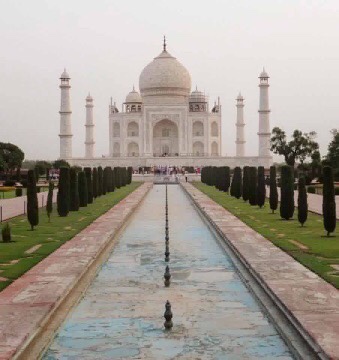
A pre-dawn wake up call reminded us that today was the day we got visit the Taj, a place I have ALWAYS wanted to tick off the bucket list. On arrival, after a short buggy ride, security check and walk, through the gate we emerged…to a sea of people who had decided to get up just as early as we had. Now don’t get me wrong, I wasn’t expecting a private viewing however, the mysticism and beauty of this magnificent place was certainly slightly marred by the throngs of people, queuing for photos and the shiny sliver railings guiding our route. Still, ever the optimist, I politely queued, smiled for my pictures and moved along with the rest of the crowd.
Despite not being the idyllic center of Zen that I had hoped for, the Taj Mahal is still pretty spectacular. Make sure you take some time just to sit outside on the marble floor and take in the intricacies and detailed work that went in to the structure. Marvel at the colors and preciseness of the symmetry. From there is really isn’t difficult to see how this became one of the World Wonders.


On to I’timād-Ud-Daulah, also known as the Baby Taj or the Jewelry box. Pre-dating the Taj Mahal, this much smaller but no less intricate piece of architecture was my favorite place to visit in Agra. For most of our time there we were the only visitors, allowing us the luxury of meandering around the water gardens (with no water at this time of year though unfortunately), and really taking in the complexity of the design. An Insta lovers must see place for photos with a love story at its foundations, it is safe to say that the Baby Taj captured a piece of my heart in India.
Tip: Other places visited in Agra included Agra Fort and Fatehpur Sikri.
On our long drive down to Ranthambore, we opted to stop at Abhaneri to visit the Chand Baori step well and Harshat Mata temple.


Chand Baori, being one of the largest step wells with 3500 steps is certainly a sight worth seeing. As with all of the other architecture we had seen, these steps were built in perfect symmetry, creating a beautiful geometric pattern.


Harshat Mata temple, very much still a fully functioning temple for the village was absolutely stunning when we visited at sunset. The small, run down temple, has a rugged beauty. After ringing the bell, we were invited to receive a blessing from the Goddess of Happiness and Joy for whom this temple is enshrined to, I had final found my moment of Zen moment in India.
Ranthambore
Now Ranthambore is not normally included in the so called ‘Golden Triangle’ tourist route however it is something that we opted to include so that we would have the great privilege of witnessing the majestic tiger in its natural habitat. I had flash backs from my safari’s in South Africa, sustainable tourism and conservation at the forefront of everyone’s mind, but what I found was a money making tourist trap with no regard for the boundaries that should be afforded to these amazing animals.


Maybe I’m being harsh, the early morning safari was acceptable, there were few jeeps in the area we entered and when we were waiting for the tigers to emerge from their well camouflaged spots there was a silent air of anticipation and excitement. The afternoon safari however, could not have been more different. With people shouting, children screaming and the jeeps almost chasing the tigers when they were seen, this is unfortunately not an activity that I would choose to take part in again.

Ultimately, I am hugely thankful to have had the honor to have witnessed these big cats in their natural habitats, and I give major props to the guides who are doing their best to look after the welfare of these animals whilst keeping the tourists who have no interest in animal conservation happy.
Jaipur
Jaipur, know as the pink city due to the color of the old city boundary walls, was certainly my favorite of the cities we visited on this trip. Cleaner and less crowded, you could almost say it was a breath of fresh air.
Monkey Temple was one of our stops. The name conjured up images of a Jungle Book type scene with King Louis and his minion monkeys but this could not have been any different. In stark contrast to the monkeys I had previously encountered in places like Bali, these monkeys were far more wild and vicious when encountering visitors, certainly not a place to take your children, however again, the architecture here is beautiful, and if you look closely you will see the locals that live here going about their daily business.


If you are a fan of astronomy then Jantar Mantar Observatory is well worth a visit. With a collection a 19 astronomical instruments, including the world biggest sundial it is certainly interesting to see.


One place you cannot miss whilst in Jaipur in the Amber Fort. The architecture is stunning, so intricate, delicate and very clever in its design.


Be sure to take some time and explore all 6 sections of the fort, including 4 courtyards, the Sila Devi Temple and the Palace of Man Singh I. Every section is truly Insta worthy.
Note: There is concern about travel up to the fort as elephant rides do seem to be very mainstream here. We politely declined the offer form our guide and happily took a tuk tuk up instead. The exploited elephants are made to trek up and down the hill to the fort dozens of time a day, even in the scorching summer heat. Whilst I understand that this is how some people make their money, I 100% cannot condone their actions and do not agree with the practice in the slightest.
Overall I had a great time in India. Whilst it was not the spiritual enlightening movies had me dreaming of, it was very interesting to see the dynamics and juxtaposition of a country with such a high population and such a huge gap between the poor and wealthy. One thing I would recommend is spending more than 5 days here. It was just not enough time to relax, take a breath and full appreciate all of the areas that we visited. Next time, I will head further South, maybe to Goa. Would love to hear your recommendations.

 Life Wandered Not Lost